
By Gordan Jordanov
For nearly two decades, Macedonia has stood as one of the most consistent and loyal partners of the European Union. Since becoming a candidate country in 2005, Macedonia has systematically met the EU’s Copenhagen criteria:
1. Stability of institutions guaranteeing democracy, the rule of law, human rights, and protection of minorities;
2. A functioning market economy capable of competing within the EU;
3. The ability to adopt and implement the acquis communautaire — the body of EU law and obligations.
Through the Stabilisation and Association Agreement (SAA) and the Stabilisation and Association Process (SAP), Macedonia has built a strong legal and institutional partnership with the Union. It remains one of the most advanced Western Balkan candidates in terms of alignment with the acquis and implementation of EU-funded reforms through IPA III (Instrument for Pre-Accession Assistance).
Yet in 2025, Macedonia is still being held back — not because of a lack of reforms, but because of a political veto unrelated to EU law or enlargement principles. The so-called ‘French Proposal’ ties Macedonia’s accession to constitutional amendments about the Bulgarian minority — a condition outside the scope of the EU treaties. This contradicts both the Copenhagen criteria and Article 2 of the Treaty on European Union, which enshrines respect for democracy, equality, and minority rights.
A Proven European Partner
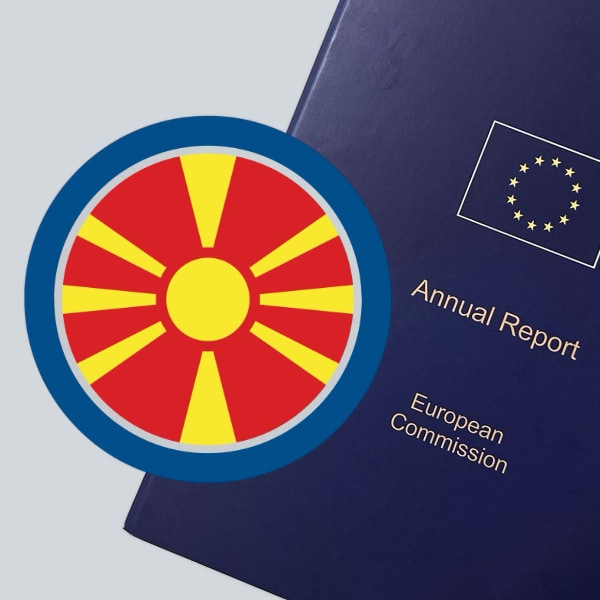
The 2025 European Commission Report acknowledges Macedonia’s consistent progress:
– Full alignment with the EU’s Common Foreign and Security Policy (CFSP), including all sanctions against Russia.
– Active participation in EU missions such as EUFOR ALTHEA and the HELBROC Battlegroup.
– Adoption of reform roadmaps on rule of law, public administration, and minority protection.
– Implementation of the Reform Agenda under the EU’s Growth Plan for the Western Balkans.
– Free and competitive elections in line with OSCE standards.
– Stable macroeconomic indicators and ongoing judicial reforms.
Macedonia is not waiting for Europe — it is already acting as Europe.
The Legal Foundation: What the Copenhagen Criteria Require
The EU’s enlargement conditions, adopted at the Copenhagen European Council (1993), define that membership depends on institutional stability, rule of law, respect for human rights and minorities, and a functioning market economy.
Macedonia already meets these obligations through:
– A Constitution guaranteeing equality for all citizens and communities.
– The Law on Prevention and Protection Against Discrimination aligned with EU directives.
– Membership in the Council of Europe and full implementation of the Framework Convention for the Protection of National Minorities.
Nothing in the EU acquis requires constitutional amendments to name specific minorities. The insistence on this change is political — not legal — and undermines the equality of candidate states under EU law.
Bulgaria’s Contradiction of EU Values
Ironically, Bulgaria — which demands constitutional recognition of its minority in Macedonia — has been condemned 14 times by the European Court of Human Rights (ECHR) for violating the rights of its own Macedonian citizens.
Cases such as Stankov and the United Macedonian Organisation Ilinden v. Bulgaria (2001), UMO Ilinden–PIRIN v. Bulgaria (2005, 2011), and Yordan Ivanov and Others v. Bulgaria (2021) expose Bulgaria’s systemic suppression of Macedonian identity and association rights. These rulings remain largely unimplemented, directly violating EU Article 2 values.
Conditioning Macedonia’s accession on Bulgaria’s demands is therefore inconsistent, rewarding non-compliance and undermining the EU’s own legal order.
Technical Progress by Cluster
Under the Enhanced Enlargement Methodology (2020), Macedonia’s accession roadmap is structured into six clusters of policy areas, each representing groups of chapters from the acquis communautaire.
|
Cluster |
Policy Scope |
Progress Summary |
Key EU Instruments |
|---|---|---|---|
|
1. Fundamentals |
Rule of law, judiciary, human rights, economic governance |
Strong progress; completed screening, adopted roadmaps on justice reform and anti-corruption; implemented IPA III ‘Windows’ for transparency. |
IPA III, Twinning, TAIEX |
|
2. Internal Market |
Free movement of goods, services, capital, and people |
Moderate progress; legislative alignment strong, enforcement limited; CE Marking and Twinning improving standards. |
Screening, Twinning, CE Marking |
|
3. Competitiveness & Inclusive Growth |
Economic policy, education, employment, digitalization |
Moderate progress; ERP and Growth Plan solid, labour absorption remains weak. |
ERP, WBIF, Growth Plan |
|
4. Green Agenda & Sustainable Connectivity |
Energy, transport, environment, climate change |
Solid progress; adoption of Integrated Energy and Climate Plan; projects under Corridor VIII ongoing. |
IPA III, Energy Community, TAIEX |
|
5. Resources, Agriculture & Cohesion |
Agriculture, fisheries, regional development |
Limited progress; weak fund absorption; NIPAC coordinating reforms under IPA III Agriculture. |
IPA III, NIPAC, SAA |
|
6. External Relations |
Foreign policy, defense, trade |
Excellent progress; 100% CFSP alignment, full readiness for Intergovernmental Conference (IGC). |
CFSP, IGC, SAA |
The Path Forward: Law, Not Politics
The Enhanced Enlargement Methodology allows the EU Council to open negotiation clusters based on merit while maintaining reversibility in case of regression. This provides a lawful path to open the Fundamentals Cluster without constitutional preconditions. The Commission can continue monitoring minority protection under existing mechanisms like Twinning, IPA III, and the SAA.
A Strategic Imperative for Europe
At a time when war in Ukraine threatens Europe’s unity and when Chinese, Turkish, and Gulf investments grow in the Balkans, the EU cannot afford hesitation. Delaying Macedonia’s accession weakens EU credibility and empowers external actors. Macedonia’s CFSP alignment, reform agenda, and economic cooperation under the Western Balkans Investment Framework already anchor it in Europe. What remains is not reform, but recognition.
Stop the Veto. Start the Future.
Macedonia has done everything that has been asked — implementing the acquis, meeting the Copenhagen criteria, reforming institutions, and promoting European peace through compromise. Now the responsibility lies with Europe: to keep its promise, uphold its law, and open the gates for a country that already stands at the threshold. If the EU truly believes in democracy, equality, and unity, then Macedonia’s place is not outside the door — it is inside Europe, where it has always belonged.
About the Author

Gordan Jordanov was born in Veles, Macedonia. Since the age of 11, he has been an active volunteer in the organization “CISV – Children International Summer Villages,” where he spent most of his adolescent period spreading the Macedonian culture worldwide. Jordanov played volleyball professionally for 10 years in the VK Borec in Veles, as well as for the Macedonian National Volleyball Team U-23. He continued his higher education in Solun as an undergraduate student at the American University of Thessaloniki, Greece, and obtained a bachelor’s degree in International Relations and Diplomacy and a minor in Human Resource Management.