
Why the Greek–Bulgarian handover of relics attributed to Tsar Samuel requires transparency, independent science, and the inclusion of Macedonian heritage institutions
By Gordan Jordanov
UMD Macedonia and Europe Director
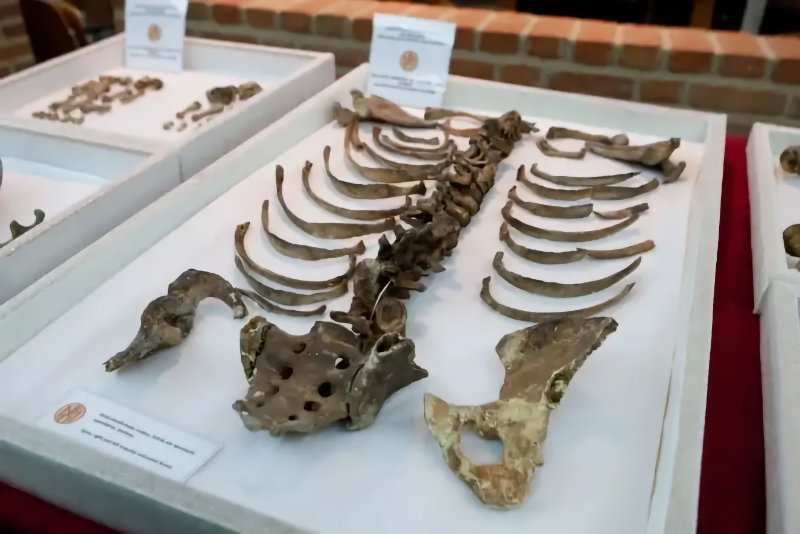
On 3 October 2026, at the Museum of Byzantine Culture in Thessaloniki (Solun), Prime Ministers Kyriakos Mitsotakis and Rumen Radev attended the handover of remains attributed to Tsar Samuel (r. 997–1014). The two countries’ culture ministers signed a handover protocol.¹ The remains came from the Basilica of Saint Achillius on an island in Lake Small Prespa. Greece also handed over human remains from three additional sarcophagi, including those attributed to Samuel’s son, Gavril Radomir.² In return, Bulgaria handed over 48 religious objects taken in 1917, during the First World War, from the Monastery of Panagia Eikosifoinissa, the Monastery of Timios Prodromos near Serres (Ser), and the Metropolis of Serres (Ser) and Nigrita.²
Bulgarian military aircraft flew the remains to Sofia, where they received state honours and were placed in the Church of Saint Sophia.³ At the ceremony, Bulgarian Patriarch Daniil declared: *“More than a millennium after his life and historic feat, Tsar Samuel returns to his people to remain forever in Bulgaria.”*³
We do not object to the return of objects taken in wartime. Europe should uphold that principle. Nor do we dispute the right of states to conclude restitution agreements.
Our concern is narrower, but fundamental.
A historical figure whose life, state and church were centred in Ohrid and Prespa has been presented as the exclusive possession of one modern nation. The communities and institutions most closely tied to those places were excluded from the process. A state ceremony has been allowed to stand in for scientific verification. At the same time, Ohrid’s own documented church treasures, taken for “temporary safekeeping” in 1916, have never been fully accounted for.
1. Where Samuel’s History Happened
Samuel ruled first from Prespa and then from Ohrid.⁴ He built the Basilica of Saint Achillius at Prespa to house the relics of that saint. It served as the seat of the church he established, which later continued at Ohrid, and he was buried there.⁴
Samuel’s Fortress still stands over Ohrid, and the city and its surroundings are inscribed on UNESCO’s World Heritage List as the Natural and Cultural Heritage of the Ohrid Region.
Ohrid is in Macedonia, not Bulgaria.
Medieval states do not map neatly onto modern borders, and we do not claim that they do. But this principle must apply equally in every direction. Samuel cannot simply be declared “Macedonian” because of today’s borders, just as he cannot be transformed into the exclusive property of modern Bulgaria through a bilateral protocol.
A ceremony announcing his permanent return “to his people” turns a shared and contested medieval heritage into exclusive national property. In doing so, it risks erasing the very region where Samuel lived, ruled, built his political and ecclesiastical centre, and was ultimately buried.
2. What European and International Standards Ask of States
None of the international instruments discussed below automatically makes the exchange unlawful. Rather, they establish standards of transparency, participation, scientific integrity and respect for the communities connected to cultural heritage.
The Council of Europe Framework Convention on the Value of Cultural Heritage for Society – the Faro Convention (2005) – defines cultural heritage as resources that people identify “independently of ownership” (Art. 2). It recognises that “everyone, alone or collectively, has the right to benefit from the cultural heritage” (Art. 4).
It further commits Parties to “respect for diversity of interpretations” and to “establish processes for conciliation to deal equitably with situations where contradictory values are placed on the same cultural heritage by different communities” (Art. 7(a)–(b)). It also calls for everyone to be encouraged “to participate in the process of identification, study, interpretation, protection, conservation and presentation of the cultural heritage” (Art. 12).⁵
Samuel’s legacy is precisely the kind of heritage to which these principles should apply.
No meaningful conciliation process involving Macedonian institutions took place.
The 1970 UNESCO Convention affirms that the true value of cultural property “can be appreciated only in relation to the fullest possible information regarding its origin, history and traditional setting.” It expressly covers “products of archaeological excavations” and objects relating to national leaders (Art. 1(b)–(c)). Article 15 permits States Parties to conclude “special agreements among themselves” concerning restitution.⁶
The exchange itself may therefore fall within a recognised mechanism of bilateral cooperation. But under the Convention’s own standard of the “fullest possible information,” the agreement, protocol, inventories and provenance documentation should be publicly available.
The ICOM Code of Ethics for Museums requires dialogue concerning return and restitution to be undertaken “in an impartial manner, based on scientific, professional and humanitarian principles” (6.2). It also requires research involving human remains, and their display, to take into account “the interests and beliefs of the community, ethnic or religious groups from whom the objects originated” (3.7, 4.3).⁷
The remains in question come from the founding ecclesiastical centre of the tradition that later continued in Ohrid. Yet Macedonian scholarly, heritage and ecclesiastical institutions were not meaningfully included in the process.
The International Covenant on Economic, Social and Cultural Rights recognises the right of everyone “to take part in cultural life” and “to enjoy the benefits of scientific progress and its applications,” while obliging states “to respect the freedom indispensable for scientific research” (Art. 15(1)(a)–(b), 15(3)).⁸
Independent scholars – including Macedonian scholars – can meaningfully exercise these rights only if the scientific record is open.
The Treaty on European Union commits the Union to respect its “rich cultural and linguistic diversity” and to ensure that “Europe’s cultural heritage is safeguarded and enhanced” (Art. 3(3)). Article 22 of the EU Charter of Fundamental Rights provides that “the Union shall respect cultural, religious and linguistic diversity.”
Bulgaria and Greece are both EU Member States. When two Member States turn a shared and contested regional heritage into a symbol of the exclusive historical narrative of one modern nation, the matter becomes a legitimate European concern.
Both states’ own bilateral commitments point in the same direction.*
In the 2018 Prespa Agreement, Greece acknowledged that, for the Macedonian side, the terms “Macedonia” and “Macedonian” denote “its territory, language and people, with their own, distinctly different, history and culture” (Art. 7(3)).⁹
In the 2017 Treaty of Friendship, Good-Neighbourliness and Cooperation, Bulgaria committed to an objective, evidence-based interpretation of history and to the joint commemoration of shared historical figures (Art. 8).¹⁰
The unilateral national presentation surrounding the events of 3 October is difficult to reconcile even with these commitments.
UMD’s official position has consistently been that these bilateral treaties should never have been signed by the then-Macedonian government, and UMD actively advocated against their adoption. Their citation here does not constitute endorsement of either agreement. Rather, they are referenced to demonstrate that even under the commitments undertaken by the parties themselves, the exclusion of the Macedonian perspective and the unilateral presentation of shared and contested heritage raise serious concerns.
3. The Scientific Question No Ceremony Can Answer
Are these Samuel’s remains?
The evidence deserves a fair and independent hearing.
Since excavations led by Nikolaos Moutsopoulos began in the 1960s, the identification has rested primarily on archaeological and anthropological evidence. Among the evidence is a severe healed arm fracture considered consistent with the historical account of Samuel’s injury at the Battle of Spercheios.⁴
Bulgarian anthropologist Victoria Ruseva, who has examined the remains, has stated that the team’s anthropological findings support much of what is historically known about Samuel, including evidence of this serious ante-mortem injury. Bulgarian researchers involved in the examination have expressed strong confidence in the identification.¹¹
At the same time, modern genetic testing had not been completed at the time of the transfer. On 3 October 2026, Bulgarian historian Prof. Milko Palangurski stated publicly that no DNA analysis had been conducted to confirm whether the remains were those of Tsar Samuel. Subsequent statements from the Bulgarian scientific team confirmed that further interdisciplinary research, including genetic analysis, was planned.¹²
These positions are not necessarily contradictory. Anthropological and archaeological evidence may strongly support an identification without genetic analysis independently confirming it.
We are therefore not asking political institutions to declare the identification either correct or incorrect.
The absence of DNA testing does not prove that the identification is wrong. Equally, genetic testing without reliable comparative material may itself be unable to establish identity conclusively.
But a state ceremony is not a peer review.
When the highest authorities of a state publicly present a historically significant identification as settled fact while additional scientific testing is still forthcoming, scholars and the public are entitled to access the evidence and methodology on which that identification rests.
The legal record matters as well.
“Donation,” “deposit,” “handover,” “exchange” and “restitution” carry different legal consequences. The public does not yet know precisely which terminology the protocol uses, which remains were transferred under which inventory numbers, or what chain of custody applied during the approximately six decades in which the remains were held.
Those are not minor technical details. They are central to establishing provenance, legal status and scientific credibility.
4. Ohrid’s Own Treasures: The 1916 Act of “Temporary Safekeeping”
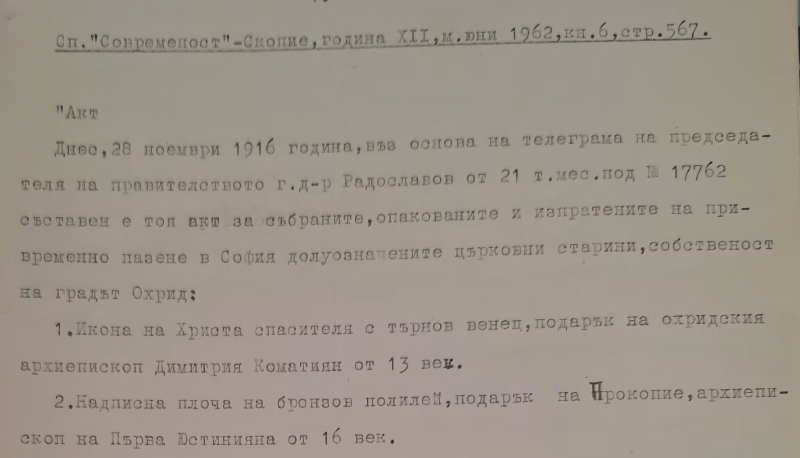
A document published in the Skopje journal Sovremenost in 1962 demonstrates that Ohrid’s church heritage is directly involved in this question – not merely symbolically.¹³
It reproduces an official Bulgarian act dated 28 November 1916, during the wartime Bulgarian occupation of Ohrid, issued on the basis of telegram No. 17762 from Prime Minister Vasil Radoslavov.
The document records church antiquities that were “collected, packed and dispatched for temporary safekeeping in Sofia” and explicitly describes them as “property of the town of Ohrid.”
The inventory reads like a catalogue of the history of the Ohrid Archbishopric:
- an icon of Christ with the crown of thorns, the gift of the 13th-century Archbishop of Ohrid Demetrios Chomatenos;
- the inscribed plate of a bronze polycandelon, the gift of Prokopije, Archbishop of Justiniana Prima, from the 16th century;
- the epitaphios of Andronikos Palaiologos, property of the Church of Saint Clement;
- the gold-enamelled crown and ivory staff of Saint Clement;
- a 13th-century chronicle of John Skylitzes;
- chalices, a reliquary, two Old Church Slavonic Gospels with silver covers and an epitaphios belonging to the Monastery of Saint Naum;
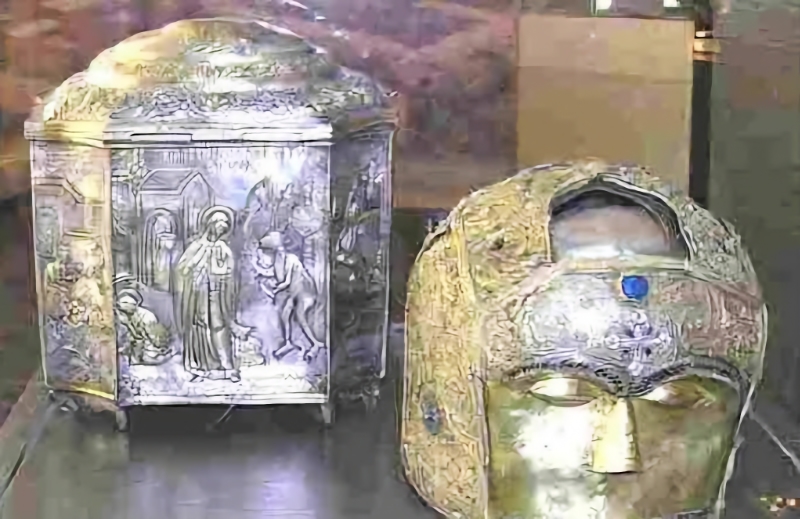
- and, as item 10, “a large silver box with the relics of Saint Matrona.”
Three conclusions follow.
First, the recorded status of these objects was custody, not ownership.
The Act describes them as Ohrid’s property and states that they were sent to Sofia for “temporary safekeeping.”
That distinction is crucial.
A custodian cannot transfer greater rights than it possesses. If Bulgaria held these objects as a temporary custodian rather than as their owner, their subsequent legal status must be examined accordingly.
Under the wording of the document itself, Bulgaria had no recorded title to the objects listed in the inventory. That makes a full accounting of their subsequent history essential.
Second, the Treaty of Neuilly establishes a directly relevant post-war restitution framework.
Articles 125 and 126 of the Treaty of Neuilly (1919) imposed explicit restitution obligations on Bulgaria concerning property removed from territories affected by its wartime occupation.
Article 125 required the return of identifiable objects and securities taken, seized or sequestrated from invaded territory in Greece, Romania or Serbia and subsequently found in Bulgarian territory. Article 126 went further, requiring Bulgaria to seek out and return records, archives and objects of archaeological, historical or artistic interest removed during the war from the territories specified in that provision.¹⁴
The precise legal application of those provisions to individual objects removed from Ohrid requires examination of the relevant territorial, succession and ownership questions and should not be assumed without further documentation.
What is beyond dispute, however, is that the post-war settlement established a clear restitution principle: cultural and historical property removed during wartime occupation was not automatically transformed into the property of the removing state.
That principle is directly relevant here because Bulgaria’s own 1916 Act describes the Ohrid objects not as Bulgarian property but as “property of the town of Ohrid,” transferred to Sofia for “temporary safekeeping.”
If that documentary record is authentic and accurately reproduced, the central question becomes unavoidable:
What subsequently happened to property that Bulgaria’s own wartime administration recorded as belonging to Ohrid and held only temporarily?
The same principle of provenance and restitution that underpins the return of cultural objects to Greece therefore makes a complete accounting of the Ohrid collection essential.
Third, the Saint Matrona question must be answered.
Reports in Macedonia have raised the question of whether the silver reliquary containing the relics of Saint Matrona is among the 48 objects Bulgaria has now handed to Greece.
This must be verified against the complete inventory and provenance documentation.
If confirmed, the implications would be serious.
It would mean that an object officially recorded in 1916 as the property of Ohrid, transferred to Sofia only for “temporary safekeeping,” was subsequently transferred to a third state as part of an exchange for remains taken from Samuel’s own Prespa basilica.
The ecclesiastical dimension makes this question even more sensitive.
In 2017, the Bulgarian Orthodox Church agreed to consider the request that it assume the role of “mother church” in relation to the Macedonian Orthodox Church. In 2022, it objected to the use of the name “Archdiocese of Ohrid.”¹⁵
A church that invokes a historical relationship with the Ohrid ecclesiastical tradition cannot simultaneously claim that legacy in relation to Macedonia while allowing documented Ohrid religious heritage to be treated as transferable property in relation to Greece.
Only publication of the complete inventory and provenance record can establish whether this occurred.
This is therefore not simply a dispute about historical memory.
It concerns documented property, a recorded custodial status and a century-old question of provenance and restitution that has never been fully accounted for.
5. Context: A Pattern Europe Already Knows
Macedonians do not raise these concerns in a vacuum.
The European Court of Human Rights has repeatedly found violations by Bulgaria and Greece of the freedom of association of organisations connected with Macedonian identity.
The cases include Sidiropoulos and Others v. Greece (1998), Stankov and the United Macedonian Organisation Ilinden v. Bulgaria (2001), Ouranio Toxo and Others v. Greece (2005), and House of Macedonian Civilisation and Others v. Greece (2015).¹⁶
The Committee of Ministers of the Council of Europe continues to supervise compliance with the Ilinden group of judgments.
This context matters.
When two states with such a record agree exclusively between themselves on how heritage intimately connected with Macedonia, Ohrid, Prespa and Macedonian cultural memory will be transferred and publicly presented, the communities concerned are entitled to ask for transparency, participation and safeguards.
6. A Precedent Europe Should Not Set
This case extends far beyond one set of remains.
If a diplomatic exchange can be presented as proof of exclusive national ownership of a medieval ruler and his ecclesiastical legacy, and if cultural objects documented as having been held only “temporarily” can be transferred without a complete public accounting of their provenance and legal status, Europe risks opening a Pandora’s box.
The Balkans contain countless historical figures, churches, manuscripts, relics, archaeological objects and cultural traditions whose histories cross today’s borders.
Modern borders cannot retroactively divide the medieval past into exclusive national possessions.
Nor should bilateral political arrangements between modern states determine, without broader consultation, who may speak for a shared cultural inheritance.
The Faro Convention, the UNESCO framework and the European Union’s own principles point in another direction:
towards transparency, evidence, participation, scientific integrity and conciliation.
Our Requests
We call on the European Commission; the European Parliament, particularly its CULT and AFET Committees; the Council of the European Union; the European External Action Service; and the Council of Europe, together with UNESCO, ICOM, ICOMOS, ICCROM and Europa Nostra, to support the following:
1. Publication of the agreement and handover protocol, together with the complete inventory of the 48 objects, including the provenance, inventory number and 1917 acquisition record of each object (UNESCO 1970, Preamble and Art. 15).
2. An independent provenance review of all 48 objects against the 1916 Ohrid Act, with particular attention to item 10 – the silver reliquary containing the relics of Saint Matrona.
3. A complete accounting by Bulgaria of every object listed in the 1916 Act, identifying which objects were subsequently returned, which remain in Bulgarian institutions, and whether any have been transferred elsewhere.
4. The return of any Ohrid objects still held under the documented status of “temporary safekeeping,” including, where appropriate, referral to UNESCO’s Intergovernmental Committee for Promoting the Return of Cultural Property to its Countries of Origin or its Restitution in Case of Illicit Appropriation, whose mandate can facilitate disputes involving losses predating the 1970 Convention.
5. An independent international scientific review of the identification of the remains attributed to Tsar Samuel, including publication of the relevant archaeological and anthropological documentation and the results of any subsequent genetic, isotopic or other scientific testing.
6. A Faro Convention-based process of dialogue and conciliation that includes Macedonian scholarly and heritage institutions and the Macedonian Orthodox Church – Archdiocese of Ohrid (Faro Convention, Arts. 7 and 12).
7. Public presentation of Tsar Samuel that accurately reflects his documented connections to Ohrid, Prespa and Macedonia, rather than reducing a complex medieval legacy to the exclusive national narrative of any one modern state.
8. Attention from the Committee of Ministers of the Council of Europe to the broader context in which this exchange has taken place, including its continuing supervision of Strasbourg judgments concerning Macedonian organisations and communities.
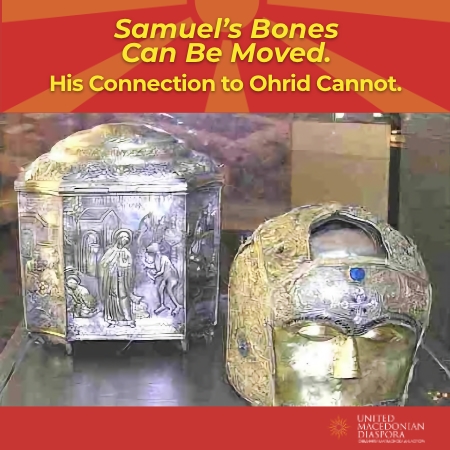
Samuel’s Bones Can Be Moved. His Connection to Ohrid Cannot.
Human remains can cross borders.
Protocols can be signed.
Military aircraft can carry a coffin from one modern capital to another.
Ceremonies can declare that a medieval ruler has “returned to his people.”
But geography, documentary evidence and historical memory cannot be transported by decree.
Samuel ruled from Prespa and Ohrid. His fortress still rises above Ohrid. His ecclesiastical centre developed within the tradition that continued there. His remains were found in the Prespa region where he built the Basilica of Saint Achillius.
Samuel’s bones can be moved. His connection to Ohrid cannot.
Nor can the documentary record simply disappear.
Bulgaria’s own 1916 Act states that Ohrid’s treasures were taken to Sofia for “temporary safekeeping.” More than a century later, their fate has still not been fully accounted for.
If Europe accepts the principle that cultural property removed during wartime should be returned, that principle must be applied consistently.
If Europe believes that shared cultural heritage belongs to communities as well as states, those communities must be heard.
If science is invoked to identify human remains, the scientific evidence must remain open to scrutiny.
And if reconciliation is truly the objective, history cannot be settled through exclusive bilateral arrangements that leave one of the communities most intimately connected to that history outside the room.
Evidence, equal respect, transparency and honest dialogue might.
Notes
1. BGNES, “Bulgaria receives Tsar Samuel’s remains, returns church treasures to Greece,” 3 October 2026; Hürriyet Daily News, “Greece returns remains of medieval Tsar to Bulgaria,” October 2026.
2. Medievalists.net, “Greece to Return Remains of Medieval Tsar Samuel to Bulgaria,” September 2026 (quoting the Greek Ministry of Culture).
3. Hürriyet Daily News, “Greece returns remains of medieval Tsar to Bulgaria,” October 2026.
4. N. Moutsopoulos, excavation reports concerning the Basilica of Saint Achillius, Prespa (from the 1960s onwards).
5. Council of Europe, Framework Convention on the Value of Cultural Heritage for Society (CETS No. 199), Faro, 27 October 2005, Arts. 2, 4, 7 and 12.
6. UNESCO, Convention on the Means of Prohibiting and Preventing the Illicit Import, Export and Transfer of Ownership of Cultural Property, Paris, 14 November 1970, Preamble, Arts. 1 and 15.
7. International Council of Museums (ICOM), Code of Ethics for Museums, sections 3.7, 4.3 and 6.2.
8. International Covenant on Economic, Social and Cultural Rights (1966), Art. 15.
9. Final Agreement for the Settlement of the Differences (Prespa Agreement), 17 June 2018, Art. 7.
10. Treaty of Friendship, Good-Neighbourliness and Cooperation between the Republic of Bulgaria and the Republic of Macedonia, 1 August 2017, Art. 8.
11. Bulgarian National Television (BNT), “Цар Самуил през очите на антрополозите: Какво разкриват костите му” [“Tsar Samuel Through the Eyes of Anthropologists: What His Bones Reveal”], 2 October 2026, including statements by anthropologist Victoria Ruseva concerning the anthropological examination of the remains and further planned research.
12. NOVA, “Проф. Милко Палангурски: Няма ДНК анализ на тленните останки, за да се потвърди дали са на цар Самуил” [“Prof. Milko Palangurski: There Is No DNA Analysis of the Remains to Confirm Whether They Are Those of Tsar Samuel”], 3 October 2026. See also Bulgarian News Agency (BTA), 5 October 2026, reporting statements concerning forthcoming interdisciplinary research on the remains, including further scientific examination.
13. “Act” of 28 November 1916, reproduced in Sovremenost (Skopje), year XII, no. 6, June 1962, p. 567.
14. Treaty of Peace between the Allied and Associated Powers and Bulgaria, signed at Neuilly-sur-Seine, 27 November 1919, Arts. 125–126. Article 125 addresses the return of identifiable objects and securities taken, seized or sequestrated from invaded territory and found in Bulgaria; Article 126 addresses records, archives and objects of archaeological, historical or artistic interest removed during the war from the territories specified therein.
15. Holy Synod of the Bulgarian Orthodox Church, decision of 27 November 2017; Bulgarian Orthodox Church statements following the Ecumenical Patriarchate’s decision of 9 May 2022.
16. European Court of Human Rights: Sidiropoulos and Others v. Greece, 10 July 1998; Stankov and the United Macedonian Organisation Ilinden v. Bulgaria, 2 October 2001; Ouranio Toxo and Others v. Greece, 20 October 2005; House of Macedonian Civilisation and Others v. Greece, 9 July 2015.
Why the Greek–Bulgarian handover of relics attributed to Tsar Samuel requires transparency, independent science, and the inclusion of Macedonian heritage institutions
By Gordan Jordanov
UMD Macedonia and Europe Director
On 3 October 2026, at the Museum of Byzantine Culture in Thessaloniki (Solun), Prime Ministers Kyriakos Mitsotakis and Rumen Radev attended the handover of remains attributed to Tsar Samuel (r. 997–1014). The two countries’ culture ministers signed a handover protocol.¹ The remains came from the Basilica of Saint Achillius on an island in Lake Small Prespa. Greece also handed over human remains from three additional sarcophagi, including those attributed to Samuel’s son, Gavril Radomir.² In return, Bulgaria handed over 48 religious objects taken in 1917, during the First World War, from the Monastery of Panagia Eikosifoinissa, the Monastery of Timios Prodromos near Serres (Ser), and the Metropolis of Serres (Ser) and Nigrita.²
Bulgarian military aircraft flew the remains to Sofia, where they received state honours and were placed in the Church of Saint Sophia.³ At the ceremony, Bulgarian Patriarch Daniil declared: *“More than a millennium after his life and historic feat, Tsar Samuel returns to his people to remain forever in Bulgaria.”*³
We do not object to the return of objects taken in wartime. Europe should uphold that principle. Nor do we dispute the right of states to conclude restitution agreements.
Our concern is narrower, but fundamental.
A historical figure whose life, state and church were centred in Ohrid and Prespa has been presented as the exclusive possession of one modern nation. The communities and institutions most closely tied to those places were excluded from the process. A state ceremony has been allowed to stand in for scientific verification. At the same time, Ohrid’s own documented church treasures, taken for “temporary safekeeping” in 1916, have never been fully accounted for.
1. Where Samuel’s History Happened
Samuel ruled first from Prespa and then from Ohrid.⁴ He built the Basilica of Saint Achillius at Prespa to house the relics of that saint. It served as the seat of the church he established, which later continued at Ohrid, and he was buried there.⁴
Samuel’s Fortress still stands over Ohrid, and the city and its surroundings are inscribed on UNESCO’s World Heritage List as the Natural and Cultural Heritage of the Ohrid Region.
Ohrid is in Macedonia, not Bulgaria.
Medieval states do not map neatly onto modern borders, and we do not claim that they do. But this principle must apply equally in every direction. Samuel cannot simply be declared “Macedonian” because of today’s borders, just as he cannot be transformed into the exclusive property of modern Bulgaria through a bilateral protocol.
A ceremony announcing his permanent return “to his people” turns a shared and contested medieval heritage into exclusive national property. In doing so, it risks erasing the very region where Samuel lived, ruled, built his political and ecclesiastical centre, and was ultimately buried.
2. What European and International Standards Ask of States
None of the international instruments discussed below automatically makes the exchange unlawful. Rather, they establish standards of transparency, participation, scientific integrity and respect for the communities connected to cultural heritage.
The Council of Europe Framework Convention on the Value of Cultural Heritage for Society – the Faro Convention (2005) – defines cultural heritage as resources that people identify “independently of ownership” (Art. 2). It recognises that “everyone, alone or collectively, has the right to benefit from the cultural heritage” (Art. 4).
It further commits Parties to “respect for diversity of interpretations” and to “establish processes for conciliation to deal equitably with situations where contradictory values are placed on the same cultural heritage by different communities” (Art. 7(a)–(b)). It also calls for everyone to be encouraged “to participate in the process of identification, study, interpretation, protection, conservation and presentation of the cultural heritage” (Art. 12).⁵
Samuel’s legacy is precisely the kind of heritage to which these principles should apply.
No meaningful conciliation process involving Macedonian institutions took place.
The 1970 UNESCO Convention affirms that the true value of cultural property “can be appreciated only in relation to the fullest possible information regarding its origin, history and traditional setting.” It expressly covers “products of archaeological excavations” and objects relating to national leaders (Art. 1(b)–(c)). Article 15 permits States Parties to conclude “special agreements among themselves” concerning restitution.⁶
The exchange itself may therefore fall within a recognised mechanism of bilateral cooperation. But under the Convention’s own standard of the “fullest possible information,” the agreement, protocol, inventories and provenance documentation should be publicly available.
The ICOM Code of Ethics for Museums requires dialogue concerning return and restitution to be undertaken “in an impartial manner, based on scientific, professional and humanitarian principles” (6.2). It also requires research involving human remains, and their display, to take into account “the interests and beliefs of the community, ethnic or religious groups from whom the objects originated” (3.7, 4.3).⁷
The remains in question come from the founding ecclesiastical centre of the tradition that later continued in Ohrid. Yet Macedonian scholarly, heritage and ecclesiastical institutions were not meaningfully included in the process.
The International Covenant on Economic, Social and Cultural Rights recognises the right of everyone “to take part in cultural life” and “to enjoy the benefits of scientific progress and its applications,” while obliging states “to respect the freedom indispensable for scientific research” (Art. 15(1)(a)–(b), 15(3)).⁸
Independent scholars – including Macedonian scholars – can meaningfully exercise these rights only if the scientific record is open.
The Treaty on European Union commits the Union to respect its “rich cultural and linguistic diversity” and to ensure that “Europe’s cultural heritage is safeguarded and enhanced” (Art. 3(3)). Article 22 of the EU Charter of Fundamental Rights provides that “the Union shall respect cultural, religious and linguistic diversity.”
Bulgaria and Greece are both EU Member States. When two Member States turn a shared and contested regional heritage into a symbol of the exclusive historical narrative of one modern nation, the matter becomes a legitimate European concern.
Both states’ own bilateral commitments point in the same direction.*
In the 2018 Prespa Agreement, Greece acknowledged that, for the Macedonian side, the terms “Macedonia” and “Macedonian” denote “its territory, language and people, with their own, distinctly different, history and culture” (Art. 7(3)).⁹
In the 2017 Treaty of Friendship, Good-Neighbourliness and Cooperation, Bulgaria committed to an objective, evidence-based interpretation of history and to the joint commemoration of shared historical figures (Art. 8).¹⁰
The unilateral national presentation surrounding the events of 3 October is difficult to reconcile even with these commitments.
UMD’s official position has consistently been that these bilateral treaties should never have been signed by the then-Macedonian government, and UMD actively advocated against their adoption. Their citation here does not constitute endorsement of either agreement. Rather, they are referenced to demonstrate that even under the commitments undertaken by the parties themselves, the exclusion of the Macedonian perspective and the unilateral presentation of shared and contested heritage raise serious concerns.
3. The Scientific Question No Ceremony Can Answer
Are these Samuel’s remains?
The evidence deserves a fair and independent hearing.
Since excavations led by Nikolaos Moutsopoulos began in the 1960s, the identification has rested primarily on archaeological and anthropological evidence. Among the evidence is a severe healed arm fracture considered consistent with the historical account of Samuel’s injury at the Battle of Spercheios.⁴
Bulgarian anthropologist Victoria Ruseva, who has examined the remains, has stated that the team’s anthropological findings support much of what is historically known about Samuel, including evidence of this serious ante-mortem injury. Bulgarian researchers involved in the examination have expressed strong confidence in the identification.¹¹
At the same time, modern genetic testing had not been completed at the time of the transfer. On 3 October 2026, Bulgarian historian Prof. Milko Palangurski stated publicly that no DNA analysis had been conducted to confirm whether the remains were those of Tsar Samuel. Subsequent statements from the Bulgarian scientific team confirmed that further interdisciplinary research, including genetic analysis, was planned.¹²
These positions are not necessarily contradictory. Anthropological and archaeological evidence may strongly support an identification without genetic analysis independently confirming it.
We are therefore not asking political institutions to declare the identification either correct or incorrect.
The absence of DNA testing does not prove that the identification is wrong. Equally, genetic testing without reliable comparative material may itself be unable to establish identity conclusively.
But a state ceremony is not a peer review.
When the highest authorities of a state publicly present a historically significant identification as settled fact while additional scientific testing is still forthcoming, scholars and the public are entitled to access the evidence and methodology on which that identification rests.
The legal record matters as well.
“Donation,” “deposit,” “handover,” “exchange” and “restitution” carry different legal consequences. The public does not yet know precisely which terminology the protocol uses, which remains were transferred under which inventory numbers, or what chain of custody applied during the approximately six decades in which the remains were held.
Those are not minor technical details. They are central to establishing provenance, legal status and scientific credibility.
4. Ohrid’s Own Treasures: The 1916 Act of “Temporary Safekeeping”
A document published in the Skopje journal Sovremenost in 1962 demonstrates that Ohrid’s church heritage is directly involved in this question – not merely symbolically.¹³
It reproduces an official Bulgarian act dated 28 November 1916, during the wartime Bulgarian occupation of Ohrid, issued on the basis of telegram No. 17762 from Prime Minister Vasil Radoslavov.
The document records church antiquities that were “collected, packed and dispatched for temporary safekeeping in Sofia” and explicitly describes them as “property of the town of Ohrid.”
The inventory reads like a catalogue of the history of the Ohrid Archbishopric:
- an icon of Christ with the crown of thorns, the gift of the 13th-century Archbishop of Ohrid Demetrios Chomatenos;
- the inscribed plate of a bronze polycandelon, the gift of Prokopije, Archbishop of Justiniana Prima, from the 16th century;
- the epitaphios of Andronikos Palaiologos, property of the Church of Saint Clement;
- the gold-enamelled crown and ivory staff of Saint Clement;
- a 13th-century chronicle of John Skylitzes;
- chalices, a reliquary, two Old Church Slavonic Gospels with silver covers and an epitaphios belonging to the Monastery of Saint Naum;
- and, as item 10, “a large silver box with the relics of Saint Matrona.”
Three conclusions follow.
First, the recorded status of these objects was custody, not ownership.
The Act describes them as Ohrid’s property and states that they were sent to Sofia for “temporary safekeeping.”
That distinction is crucial.
A custodian cannot transfer greater rights than it possesses. If Bulgaria held these objects as a temporary custodian rather than as their owner, their subsequent legal status must be examined accordingly.
Under the wording of the document itself, Bulgaria had no recorded title to the objects listed in the inventory. That makes a full accounting of their subsequent history essential.
Second, the Treaty of Neuilly establishes a directly relevant post-war restitution framework.
Articles 125 and 126 of the Treaty of Neuilly (1919) imposed explicit restitution obligations on Bulgaria concerning property removed from territories affected by its wartime occupation.
Article 125 required the return of identifiable objects and securities taken, seized or sequestrated from invaded territory in Greece, Romania or Serbia and subsequently found in Bulgarian territory. Article 126 went further, requiring Bulgaria to seek out and return records, archives and objects of archaeological, historical or artistic interest removed during the war from the territories specified in that provision.¹⁴
The precise legal application of those provisions to individual objects removed from Ohrid requires examination of the relevant territorial, succession and ownership questions and should not be assumed without further documentation.
What is beyond dispute, however, is that the post-war settlement established a clear restitution principle: cultural and historical property removed during wartime occupation was not automatically transformed into the property of the removing state.
That principle is directly relevant here because Bulgaria’s own 1916 Act describes the Ohrid objects not as Bulgarian property but as “property of the town of Ohrid,” transferred to Sofia for “temporary safekeeping.”
If that documentary record is authentic and accurately reproduced, the central question becomes unavoidable:
What subsequently happened to property that Bulgaria’s own wartime administration recorded as belonging to Ohrid and held only temporarily?
The same principle of provenance and restitution that underpins the return of cultural objects to Greece therefore makes a complete accounting of the Ohrid collection essential.
Third, the Saint Matrona question must be answered.
Reports in Macedonia have raised the question of whether the silver reliquary containing the relics of Saint Matrona is among the 48 objects Bulgaria has now handed to Greece.
This must be verified against the complete inventory and provenance documentation.
If confirmed, the implications would be serious.
It would mean that an object officially recorded in 1916 as the property of Ohrid, transferred to Sofia only for “temporary safekeeping,” was subsequently transferred to a third state as part of an exchange for remains taken from Samuel’s own Prespa basilica.
The ecclesiastical dimension makes this question even more sensitive.
In 2017, the Bulgarian Orthodox Church agreed to consider the request that it assume the role of “mother church” in relation to the Macedonian Orthodox Church. In 2022, it objected to the use of the name “Archdiocese of Ohrid.”¹⁵
A church that invokes a historical relationship with the Ohrid ecclesiastical tradition cannot simultaneously claim that legacy in relation to Macedonia while allowing documented Ohrid religious heritage to be treated as transferable property in relation to Greece.
Only publication of the complete inventory and provenance record can establish whether this occurred.
This is therefore not simply a dispute about historical memory.
It concerns documented property, a recorded custodial status and a century-old question of provenance and restitution that has never been fully accounted for.
5. Context: A Pattern Europe Already Knows
Macedonians do not raise these concerns in a vacuum.
The European Court of Human Rights has repeatedly found violations by Bulgaria and Greece of the freedom of association of organisations connected with Macedonian identity.
The cases include Sidiropoulos and Others v. Greece (1998), Stankov and the United Macedonian Organisation Ilinden v. Bulgaria (2001), Ouranio Toxo and Others v. Greece (2005), and House of Macedonian Civilisation and Others v. Greece (2015).¹⁶
The Committee of Ministers of the Council of Europe continues to supervise compliance with the Ilinden group of judgments.
This context matters.
When two states with such a record agree exclusively between themselves on how heritage intimately connected with Macedonia, Ohrid, Prespa and Macedonian cultural memory will be transferred and publicly presented, the communities concerned are entitled to ask for transparency, participation and safeguards.
6. A Precedent Europe Should Not Set
This case extends far beyond one set of remains.
If a diplomatic exchange can be presented as proof of exclusive national ownership of a medieval ruler and his ecclesiastical legacy, and if cultural objects documented as having been held only “temporarily” can be transferred without a complete public accounting of their provenance and legal status, Europe risks opening a Pandora’s box.
The Balkans contain countless historical figures, churches, manuscripts, relics, archaeological objects and cultural traditions whose histories cross today’s borders.
Modern borders cannot retroactively divide the medieval past into exclusive national possessions.
Nor should bilateral political arrangements between modern states determine, without broader consultation, who may speak for a shared cultural inheritance.
The Faro Convention, the UNESCO framework and the European Union’s own principles point in another direction:
towards transparency, evidence, participation, scientific integrity and conciliation.
Our Requests
We call on the European Commission; the European Parliament, particularly its CULT and AFET Committees; the Council of the European Union; the European External Action Service; and the Council of Europe, together with UNESCO, ICOM, ICOMOS, ICCROM and Europa Nostra, to support the following:
1. Publication of the agreement and handover protocol, together with the complete inventory of the 48 objects, including the provenance, inventory number and 1917 acquisition record of each object (UNESCO 1970, Preamble and Art. 15).
2. An independent provenance review of all 48 objects against the 1916 Ohrid Act, with particular attention to item 10 – the silver reliquary containing the relics of Saint Matrona.
3. A complete accounting by Bulgaria of every object listed in the 1916 Act, identifying which objects were subsequently returned, which remain in Bulgarian institutions, and whether any have been transferred elsewhere.
4. The return of any Ohrid objects still held under the documented status of “temporary safekeeping,” including, where appropriate, referral to UNESCO’s Intergovernmental Committee for Promoting the Return of Cultural Property to its Countries of Origin or its Restitution in Case of Illicit Appropriation, whose mandate can facilitate disputes involving losses predating the 1970 Convention.
5. An independent international scientific review of the identification of the remains attributed to Tsar Samuel, including publication of the relevant archaeological and anthropological documentation and the results of any subsequent genetic, isotopic or other scientific testing.
6. A Faro Convention-based process of dialogue and conciliation that includes Macedonian scholarly and heritage institutions and the Macedonian Orthodox Church – Archdiocese of Ohrid (Faro Convention, Arts. 7 and 12).
7. Public presentation of Tsar Samuel that accurately reflects his documented connections to Ohrid, Prespa and Macedonia, rather than reducing a complex medieval legacy to the exclusive national narrative of any one modern state.
8. Attention from the Committee of Ministers of the Council of Europe to the broader context in which this exchange has taken place, including its continuing supervision of Strasbourg judgments concerning Macedonian organisations and communities.
Samuel’s Bones Can Be Moved. His Connection to Ohrid Cannot.
Human remains can cross borders.
Protocols can be signed.
Military aircraft can carry a coffin from one modern capital to another.
Ceremonies can declare that a medieval ruler has “returned to his people.”
But geography, documentary evidence and historical memory cannot be transported by decree.
Samuel ruled from Prespa and Ohrid. His fortress still rises above Ohrid. His ecclesiastical centre developed within the tradition that continued there. His remains were found in the Prespa region where he built the Basilica of Saint Achillius.
Samuel’s bones can be moved. His connection to Ohrid cannot.
Nor can the documentary record simply disappear.
Bulgaria’s own 1916 Act states that Ohrid’s treasures were taken to Sofia for “temporary safekeeping.” More than a century later, their fate has still not been fully accounted for.
If Europe accepts the principle that cultural property removed during wartime should be returned, that principle must be applied consistently.
If Europe believes that shared cultural heritage belongs to communities as well as states, those communities must be heard.
If science is invoked to identify human remains, the scientific evidence must remain open to scrutiny.
And if reconciliation is truly the objective, history cannot be settled through exclusive bilateral arrangements that leave one of the communities most intimately connected to that history outside the room.
Evidence, equal respect, transparency and honest dialogue might.
Notes
1. BGNES, “Bulgaria receives Tsar Samuel’s remains, returns church treasures to Greece,” 3 October 2026; Hürriyet Daily News, “Greece returns remains of medieval Tsar to Bulgaria,” October 2026.
2. Medievalists.net, “Greece to Return Remains of Medieval Tsar Samuel to Bulgaria,” September 2026 (quoting the Greek Ministry of Culture).
3. Hürriyet Daily News, “Greece returns remains of medieval Tsar to Bulgaria,” October 2026.
4. N. Moutsopoulos, excavation reports concerning the Basilica of Saint Achillius, Prespa (from the 1960s onwards).
5. Council of Europe, Framework Convention on the Value of Cultural Heritage for Society (CETS No. 199), Faro, 27 October 2005, Arts. 2, 4, 7 and 12.
6. UNESCO, Convention on the Means of Prohibiting and Preventing the Illicit Import, Export and Transfer of Ownership of Cultural Property, Paris, 14 November 1970, Preamble, Arts. 1 and 15.
7. International Council of Museums (ICOM), Code of Ethics for Museums, sections 3.7, 4.3 and 6.2.
8. International Covenant on Economic, Social and Cultural Rights (1966), Art. 15.
9. Final Agreement for the Settlement of the Differences (Prespa Agreement), 17 June 2018, Art. 7.
10. Treaty of Friendship, Good-Neighbourliness and Cooperation between the Republic of Bulgaria and the Republic of Macedonia, 1 August 2017, Art. 8.
11. Bulgarian National Television (BNT), “Цар Самуил през очите на антрополозите: Какво разкриват костите му” [“Tsar Samuel Through the Eyes of Anthropologists: What His Bones Reveal”], 2 October 2026, including statements by anthropologist Victoria Ruseva concerning the anthropological examination of the remains and further planned research.
12. NOVA, “Проф. Милко Палангурски: Няма ДНК анализ на тленните останки, за да се потвърди дали са на цар Самуил” [“Prof. Milko Palangurski: There Is No DNA Analysis of the Remains to Confirm Whether They Are Those of Tsar Samuel”], 3 October 2026. See also Bulgarian News Agency (BTA), 5 October 2026, reporting statements concerning forthcoming interdisciplinary research on the remains, including further scientific examination.
13. “Act” of 28 November 1916, reproduced in Sovremenost (Skopje), year XII, no. 6, June 1962, p. 567.
14. Treaty of Peace between the Allied and Associated Powers and Bulgaria, signed at Neuilly-sur-Seine, 27 November 1919, Arts. 125–126. Article 125 addresses the return of identifiable objects and securities taken, seized or sequestrated from invaded territory and found in Bulgaria; Article 126 addresses records, archives and objects of archaeological, historical or artistic interest removed during the war from the territories specified therein.
15. Holy Synod of the Bulgarian Orthodox Church, decision of 27 November 2017; Bulgarian Orthodox Church statements following the Ecumenical Patriarchate’s decision of 9 May 2022.
16. European Court of Human Rights: Sidiropoulos and Others v. Greece, 10 July 1998; Stankov and the United Macedonian Organisation Ilinden v. Bulgaria, 2 October 2001; Ouranio Toxo and Others v. Greece, 20 October 2005; House of Macedonian Civilisation and Others v. Greece, 9 July 2015.
