
Article by Gordan Jordanov
UMD Macedonia and Europe Director
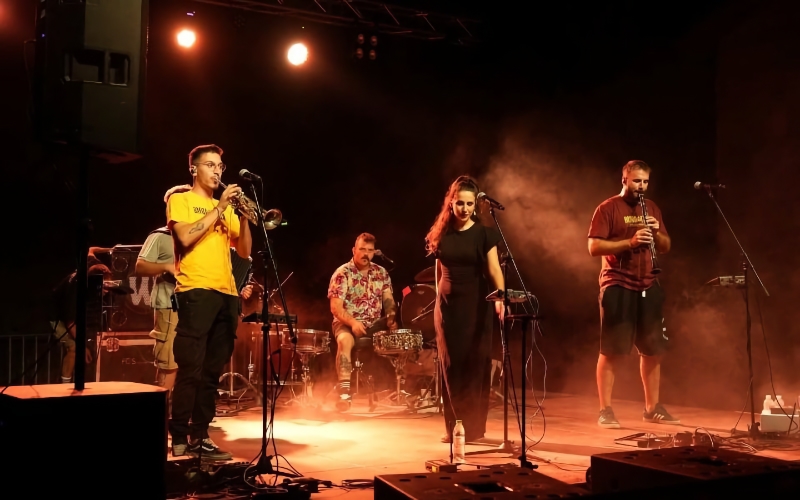
An incident in Florina (Lerin), Greece, on 22 December 2025 highlighted persistent tensions over language and minority rights at a public cultural event. The youth band Banda Entopica was performing a repertoire of Balkan music, including songs in multiple languages, when the live performance was interrupted by Florina Mayor Vasilis Giannakis, who halted the concert once a song in Macedonian began. According to multiple Greek media reports, the mayor allegedly told the musicians: “I pay you,” “you won’t sing these songs in my city,” and “who allowed you to sing in Slavic,” before stopping the performance, which drew criticism from the band and opposition voices for curtailing artistic expression. The band responded publicly that “we will sing in any language we want,” asserting their artistic autonomy and linguistic rights. Around ten audience members reportedly reacted negatively, but the incident sparked broader debate about cultural plurality rather than a local disturbance.
Mayor Giannakis is affiliated with New Democracy (ND), Greece’s main centre-right ruling party under Prime Minister Kyriakos Mitsotakis, which has governed Greece since 2019. ND positions itself as liberal-conservative but remains politically dominant in local and national offices, shaping municipal policy in regions like Florina.
The Northern Greece Musicians Association publicly supported Banda Entopica, condemning the mayor’s action as an unacceptable interference in artistic freedom and asserting that freedom of expression, including linguistic choice in music, is an inalienable democratic right. The Association emphasised that music serves as a cultural connector across borders and called on the municipal council of Florina to take a position and apologise to the musicians.
This event is not isolated but fits a long historical pattern in parts of northern Greece where speech, culture, and language associated with the Macedonian-identifying community have faced restrictions, non-recognition, or denial. In 1925, the Greek state published a school primer known as Abecedar in the Lerin dialect for Slavic-speaking children, intended to fulfil minority education obligations under early post-World War I arrangements. Despite its printing, Abecedar was never effectively distributed or integrated into schooling, becoming emblematic of unfulfilled minority language promises.
Contemporary civil-society organisations promoting Macedonian language and culture have similarly faced difficulties, including judicial and administrative challenges to recognition and operations in Greece, reflecting ongoing contestation over linguistic identity in public life.
The modern human-rights record also includes episodes of intimidation. In 2023, Archimandrite Nikodim Tsarknias, an approximately 80-year-old Macedonian Orthodox priest known for advocating religious and cultural minority rights, was assaulted in Greece in an incident widely condemned by diaspora organisations and rights observers as targeted intimidation against a minority community figure.
International human-rights monitoring has also addressed minority language and identity issues in Greece. A United Nations Human Rights Council report by Independent Expert Gay McDougall following a 2008 mission to Greece noted that the Greek government does not officially recognise a Macedonian minority nor the existence of the Macedonian language, and emphasised the need for Greece to honour its obligations under international minority-rights instruments.Older Amnesty International reporting documented that Greek authorities at times pursued prosecutions against individuals for expressions regarding the existence of a Macedonian minority and its language, underscoring challenges for freedom of expression related to minority identity issues.Historical U.S. Department of State Country Reports on Human Rights Practices have acknowledged the presence of communities identifying as Macedonian in Greece, noted that Greek authorities historically denied official minority status, and described constraints on public use of the language and cultural organisation.
Under the European Convention on Human Rights (ECHR), freedom of expression (Article 10) and freedom of peaceful assembly and association (Article 11) are protected, and any restriction on these rights must be lawful, necessary, and proportionate. Stopping a public performance because of the language of the lyrics, absent a legitimate public-safety rationale, directly engages these protections and raises concerns under Article 14 when paired with non-discrimination principles. Additionally, Article 27 of the UN International Covenant on Civil and Political Rights (ICCPR) safeguards the rights of ethnic, religious, or linguistic minorities to enjoy their culture and use their language. These treaties form a foundational human-rights framework for Greece as a Council of Europe member and are benchmarks in EU accession policy and monitoring.
The debate over minority rights in EU accession politics has been high, particularly in relation to Macedonia’s EU bid, where constitutional recognition of the Bulgarian minority has been highlighted as a key hurdle in negotiations. Yet the uneven enforcement and respect for minority linguistic and cultural rights within some EU member states underscore a glaring inconsistency: candidate states are expected to adopt constitutional minority guarantees that some long-standing EU members themselves do not fully implement in practice. This discrepancy weakens the credibility of EU rule-of-law and fundamental-rights standards.
The position of civil-society organisations such as the United Macedonian Diaspora (UMD) is to continue documenting and internationally raising such incidents so that the struggle for language dignity, identity, and cultural participation for Macedonians is heard beyond regional debate and anchored in universal human-rights discourse. Past statements from UMD and allied groups emphasise the need for systematic documentation and advocacy before international bodies including the EU, the Council of Europe, and the UN.
For human-rights advocates, policymakers, and international institutions, the Florina (Lerin) case serves as a stark reminder that cultural and linguistic expression is central, not peripheral, to the human-rights framework Europe claims to uphold. Failure to address these rights within EU borders weakens the normative force of European calls for rule of law and minority protections and reinforces the urgency of a consistent, evidence-based approach to minority rights implementation in all Council of Europe and EU member states.
References
Ekathimerini (2025) Band condemns Florina mayor for halting concert over Slavic-language song, 26 December. Available at: https://www.ekathimerini.com/culture/1290874/band-condemns-florina-mayor-for-halting-concert-over-slavic-language-song/ (Accessed: 26 December 2025).
Ethnos (2025) Σάλος στη Φλώρινα: δήμαρχος σταμάτησε συγκρότημα επειδή τραγουδούσαν σε «σλαβικό» τραγούδι [Sensation in Florina: mayor stopped band because they sang a “Slavic” song]. Available at: https://www.ethnos.gr/culture/article/392728/salossthflorinadhmarxosstamathsesygkrothmaepeidhtragoydhseslabofonotragoydi (Accessed: 26 December 2025).
Protothema (2025) Φλώρινα: Ο δήμαρχος διέκοψε βραδιά που έπαιζε μπάντα επειδή τραγουδούσαν στα σλαβικά [Florina: Mayor stopped a night where a band was playing because they sang in “Slavic”]. Available at: https://www.protothema.gr/greece/article/1748880/florina-o-dimarhos-diekopse-bada-pou-epaize-se-topiko-magazi-epeidi-tragoudousan-sta-slavika/AMP/ (Accessed: 26 December 2025).
United Nations Human Rights Council (2009) Report of the Independent Expert on Minority Issues, Gay McDougall : addendum : mission to Greece (8-16 September 2008), A/HRC/10/11/Add.3, 18 February. Available at: https://www.refworld.org/reference/mission/unhrc/2009/en/66463 (Accessed: 26 December 2025). Refworld
McDougall, G. (2008) UN Independent Expert on Minority Issues concludes her official visit to Greece, OHCHR, 16 September. Available at: https://www.ohchr.org/en/press-releases/2009/10/un-independent-expert-minority-issues-concludes-her-official-visit-greece (Accessed: 26 December 2025). OHCHR
Florina.org (2009) Report of the Independent Expert on Minority Issues, Gay McDougall Mission to Greece, 5 March. Available at: https://www.florina.org/reports.asp (Accessed: 26 December 2025). Florina
Pollitecon (n.d.) In Review: McDougall’s 2009 UN Report, Macedonians, a Narrative of Greek Minority Policy. Available at: https://www.pollitecon.com/Assets/Ebooks/MHR-Review-11.pdf (Accessed: 26 December 2025). Pollitecon
About the Author

Gordan Jordanov was born in Veles, Macedonia. Since the age of 11, he has been an active volunteer in the organization “CISV – Children International Summer Villages,” where he spent most of his adolescent period spreading the Macedonian culture worldwide. Jordanov played volleyball professionally for 10 years in the VK Borec in Veles, as well as for the Macedonian National Volleyball Team U-23. He continued his higher education in Solun as an undergraduate student at the American University of Thessaloniki, Greece, and obtained a bachelor’s degree in International Relations and Diplomacy and a minor in Human Resource Management.