
by Virginia A. Evans,
President & Executive Director of the Macedonian Film Festival Toronto
Do you mind if I take you back a few years? Now that we have celebrated 20 years of screening films with a Macedonian connection, I wanted to share this adventure. I started slowly, looking at what other ethnic groups were doing. I discovered the Turkish Film Festival, with screenings across the country—surely we could do that too. The arts have always been a passion of mine, having co-run a community theatre group for 13 years.
I decided to begin with a fundraiser for the Canadian Macedonian Historical Society to see whether our community would watch Macedonian films. It took a year to bring Milcho Manchevski to Toronto to present Dust at the Innis Theatre, University of Toronto, and the place was packed. Perhaps the community was ready for a Macedonian Film Festival.
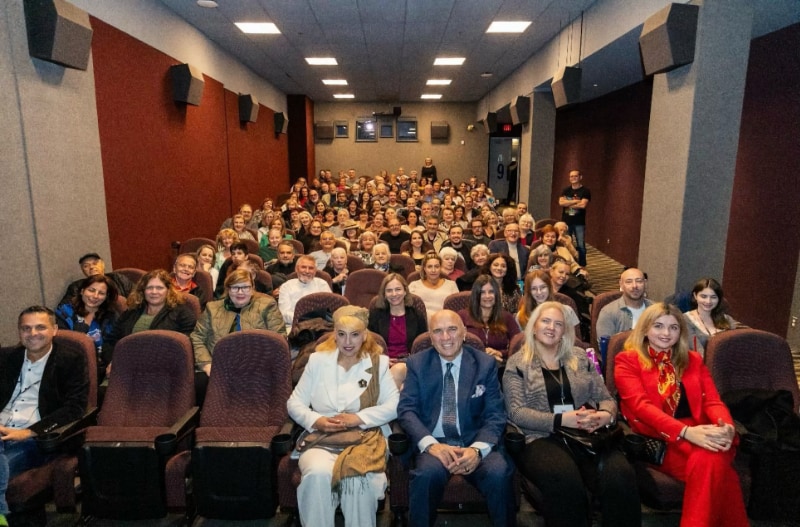
Photo of the audience during the 20th Anniversary Festival
Determined not to host it in a church basement, the festival would be in a proper cinema. Innis College, part of U of T’s film program, offered the perfect venue, and we hoped students would join our audience as well. I brought together several Macedonian women, shared the idea, and everyone was excited and willing to volunteer. I would rather collaborate with people than do all of this solo. Plus, we had crackerjack people on the committee.
So, we formed a committee, gathered volunteers, and created a steering committee to handle everything from fundraising to screening fees. It was important to pay for a screening fee. If we were going to run the festival as professionally as possible, the director and producers deserved to be paid. We printed a program, which included advertisements. We specifically focused on finding Macedonian businesses to pay for ads which helped us pay for the expenses. We even received donations before we were able to establish our charitable status.
Our eligibility for films for the MFF was Macedonian directors, producers, scriptwriters, leading actors or a location in Macedonia. We wanted Macedonian stories. This was the focus and raison d’être for this film festival. All films were viewed by a Selection committee and still are. The first year we screened 5 feature films, 3 documentaries and 4 short films. We brought director Antonio Mitrikeski to Toronto for Q&A sessions on Across the Lake and the short The Love of Kocho Topancharov. Plus, we screened the classic Miss Stone. A feature film based on real events during the fight against the Ottoman Empire in the early part of the last century.
In our first year, there were five films that were directed by women, such as Teona Strugar Mitevska, Sandra Danilovic, and Marija Dzidzeva. All these women have since produced many more films through the years. We wanted to encourage women and young Macedonians to direct, write and produce films, and gave them an opportunity to screen their films at the Macedonian Film Festival in Canada.
Over the years, we built audiences, covered expenses, and maintained our charitable status, with a volunteer Board of Directors overseeing operations. We developed a professional logo, a promotional trailer, and even adjusted our festival dates to October to avoid spring clashes with other Toronto festivals. By our second year, we screened 15 films, encouraging submissions from young filmmakers in Toronto, the U.S., and Australia, often for no submission fee. Pretty good for a bunch of women who decided to do something different, cultural, artistic and did not include food.
We had decent audiences and were able to pay for the venue and fees, while also entertaining the audience. We were also working on being declared a charitable institution, so that donations could be tax-deductible. We formed a proper Board of Directors, all volunteers. No one was paid except for those providing a service. Over the years, we were fortunate to have exceptional people on our Board.
Of course, no festival worth its name is complete without a proper logo. A friend of the committee produced the exceptional logo we still use. We even produced a trailer, still visible on our website—something not all film festivals had back then. Plus, our posters and t-shirts have always been designed by Macedonian or Canadian artists, whom we compensate for their work.
The following year, we moved the festival to October to avoid clashes with the busy spring festival season. In fact, Toronto hosts over 70 different ethnic film festivals, including Armenian, Jewish, Asian, Israeli, Black, Palestinian, Caribbean, and major festivals like TIFF and Hot Docs. It was very exciting to be joining such an awesome array of diverse and ethnic film festivals.
In our second year, we presented 15 films. We tried to seek out young filmmakers of Macedonian descent, either in Toronto, America or Australia, to submit their work. They filled out a submission form and sent a DVD—no fee required, unlike many other festivals. We encouraged our young filmmakers to submit their films, such as Nicolaou with Dance with Me.
Short films proved the perfect vehicle for young directors. At times, once their film was screened, they tended to move on to other careers, but at least they had their day in the sun by having their creations screened.
We were small… but mighty. We knew why we were doing this: sharing our stories, history, perspectives, and talent with our community and beyond. Occasionally, someone would comment that a film “didn’t have a Macedonian connection.” However, it did. Either a Macedonian had written or directed it, or it was a Macedonian story, or the location was in the three regions, or it was about Roma or Macedonian immigrants or villages in Macedonia. We even presented films directed by French, American, Slovenian, Dutch, Albanian, German, etc. directors. Sometimes we would also screen a Guest film from countries in the Balkans, because it had an important story to tell. Though overall, in one way or another, all these films had a tie to Macedonia.
From the beginning, at our first venue in the heart of the University of Toronto, we encouraged student attendance with discounts – not sure it worked. So, we now have “walk-ins” at the Carlton Cinema, in mid-Toronto, as we are always on the marquee.
By our third year in 2008, we presented Manchevski’s Shadows and Teona Mitevska’s I Am From Tito Veles. Labina Mitevska appeared in Warchild by Christian Wagner about war and loss. The documentary Next Year in Lerin told the story of 30,000 Macedonian and Greek children during the Greek Civil War.
We went on to explore Dogma films like Does it Hurt?, classics like The Red Horse and Gypsy Magic by Stole Popov, and hits like A Name is a Name by Einarsson and Miko. Bal-Can-Can gave us comedy, and Kontact a love story. Another classic war drama with Wolf’s Night. We even explored our Balkan neighbours and their stories through Some Other Stories, and presented the film that everyone knows, Makedonska Krvava Svadba (1967) Macedonian Bloody Wedding.
We celebrated Macedonians in Istanbul as well as Whose is This Song? Not to mention, we had Professor Christina Kramer give the audience a précis of the film Macedonian Saga. It was the only time we did NOT have English subtitles. The festival went on as we screened Macedonia, My Love about Macedonia as the cradle of European Christianity, while The Pursuit of Luck documented eight Macedonian men seeking brides in Russia.
Many of the films were sponsored by community members, acknowledged in our program or on our website.
At our tenth festival, we presented Milcho Manchevski’s retrospective – a real treat as he was here for every Q&A. Following with films, Empty Boxcars, chronicling the fate of Macedonia’s Jews, and the popular The Third Half, based on true events. It was in 2017 that we brought our first Macedonian actress for a Q&A during Liberation of Skopje.
Memorable films we’ve screened include Secret Ingredient, Mocking of Christ, Lake of Apples, Honeyland, and God Exists, Her Name is Petrunija, as well as TV episodes like The Family Markovski.
When the COVID-19 pandemic struck in 2020, it forced us to learn to stream films. Productions in Macedonia were sparse, but we persisted. We streamed a couple of reruns and one family adventure, The Witch Hunters. For about three years, the pickings were sparse, but we maintained smaller audiences. By 2023, we returned to theatres with Manchevski’s Willow, Goce Cvetanovski’s Business of Pleasure!, Vardan Tozija’s sci-fi M, and Tamara Kotevska’s The Walk, as well as a Slovenian comedy filmed in Macedonia.
Now in 2025, we presented a full slate of award-winning films: an aspiring DJ teen, youth in trouble, lost and lonely people, exploring the galaxy with a feature animation, documentaries about Vasil Hadzimanov, and the city of Skopje. To add on to the success of the year’s Festival, the short films remained exceptional.
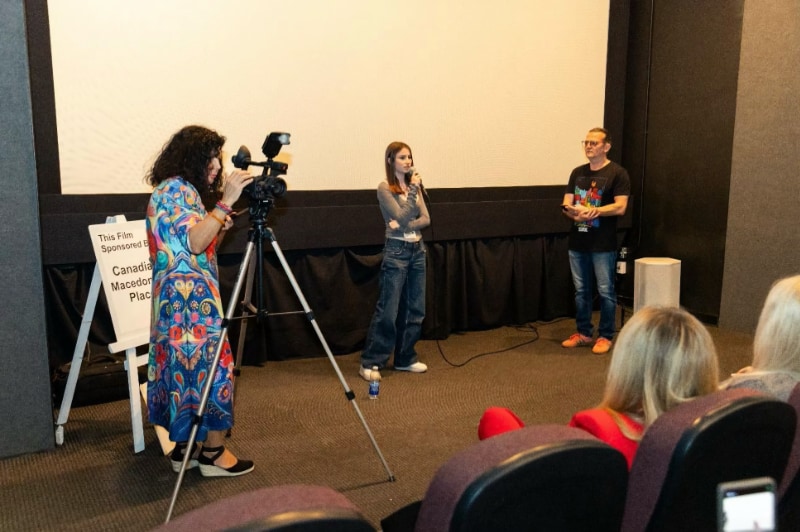
Pobeda Piskaceva covering Lilah Winkler’s Q&A with Ognen Georgievsk about her Short FIlm Between Stops
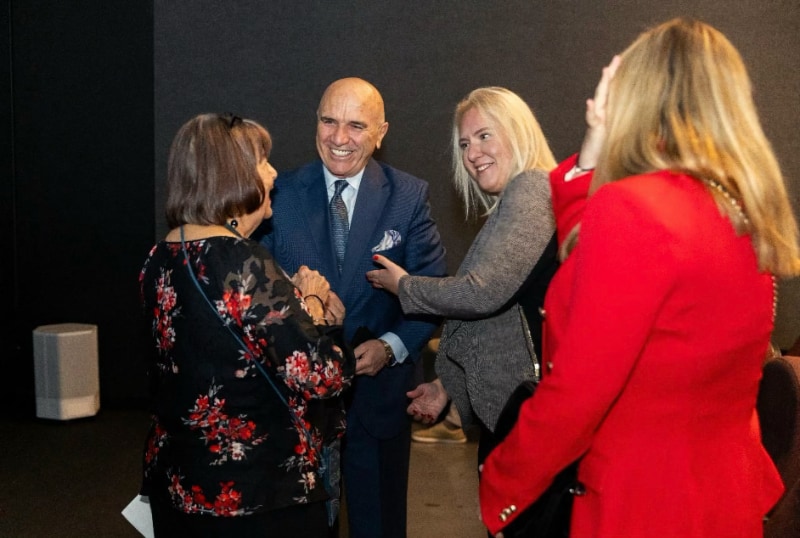
Ambassador Agron Buxhaku and Consul Sara Trajkovska of Macedonia attended the 2025 Festival
I must acknowledge the exceptional board members who have donated their time and talent to make this extraordinary event possible. These films preserve our history and culture, sharing them not only with each generation but with the larger community. Film informs, investigates, challenges, and entertains—and over 20 years, the Macedonian Film Festival has done all of that.
Thank you for joining us on this journey. It has been exciting, sometimes challenging, and always rewarding. See you at the movies!
Did you miss some of these films over the years? Why not write to us and let us know which ones you would like to see again. Check the Archives on our website.
V. Andreoff Evans ©

